![[EP01] PR in Korea: A Beginner’s Guide to the Korean Media Landscape](https://static.pulitzer.ai/homepage-blog/22/2026/03/13/103218_4d8b4a1a-2cb7-4902-87e4-650654c384a0/felix-Yx_qMAyVlMw-unsplash.jpg)
[EP01] PR in Korea: A Beginner’s Guide to the Korean Media Landscape
A beginner’s guide to PR in Korea. Learn how the Korean media landscape works, how journalists operate, and what you should know before sending a press release.
PR for Beginners — EP01
If you're new to PR in Korea, the first challenge often feels surprisingly simple: “Let’s send a press release.” But once you actually sit down to do it, things quickly become confusing.
Which Korean media outlets should you contact?
Which journalist covers your industry?
Should you send an email, make a phone call, or both?
ⓒ Unsplash
Many professionals who are new to the Korean PR environment run into these exact questions. That’s why we started this series. The PR for Beginners series explores how PR works in Korea, from understanding the local media ecosystem to communicating with journalists, writing press releases, distributing news, and tracking media coverage.
In this first article, we’ll start with the basics: what PR means in Korea and how the Korean media landscape is structured.
PR vs Marketing: Understanding the Role of PR in Korea
One of the most common misconceptions among people entering PR is confusing PR with marketing. Marketing focuses on promoting products or services to increase sales. PR (Public Relations), however, focuses on building credibility and reputation through trusted channels — especially the media.

In simple terms:
Marketing says “Our product is great — you should buy it.”
PR communicates “This is a company worth trusting.”
In Korea, where media credibility still plays a major role in shaping public perception, PR can significantly influence how brands are viewed by customers, investors, and the broader public.
Why Media Coverage Is Still Powerful in Korea
In the age of social media, brands communicate through many platforms — YouTube, Instagram, TikTok, and others. However, traditional media still carries strong credibility in Korea.

ⓒ Unsplash
According to the 2024 Media Audience Survey by the Korea Press Foundation, traditional media outlets were evaluated as relatively more trustworthy than internet-based sources. In the credibility index (5-point scale), TV news recorded the highest score at 3.90. At the same time, the report noted that news circulating on social media is often consumed without thorough verification of its original source.
This is why PR in Korea still relies heavily on news coverage. A single article in a reputable media outlet often carries more authority than a social media post. As a result, journalist relationships and press release distribution remain central to PR work in Korea.
ⓒ Unsplash
Understanding the Korean Media Landscape
Before sending press releases to dozens of outlets, it helps to understand how the Korean media ecosystem is structured. Once you understand the different types of media in Korea, it becomes much easier to identify which outlets are most likely to be interested in your story.
In PR, success often comes not from sending information everywhere, but from sending it to the right journalists.
Need help identifying the right journalists in Korea? Pulitzer AI analyzes journalist coverage data and publishing patterns to help you target the right media.
Types of Media in Korea
1. Classified by Publication Frequency

Daily Newspapers
Daily newspapers publish articles every day, which means the news cycle moves quickly. Journalists working for these outlets typically prefer concise, fact-based information rather than long explanations.
Historically, Korean daily newspapers were divided into:
Morning editions, covering news up to the previous evening
Evening editions, covering events from the same morning
In the digital news era, this distinction has become less clear. However, one thing remains constant in PR in Korea: Journalists work under strict deadlines. Because of that, timing your outreach matters.
Weekly and Monthly Publications
Publications with longer cycles — such as weekly or monthly magazines — tend to publish in-depth stories, industry trends, and interviews. If you want to share a longer brand narrative or thought leadership, these outlets can be a good fit.
2. Classified by Editorial Focus
Major National Newspapers
These large publications cover politics, economics, and society. They have strong influence and wide readership, but earning coverage can be more competitive. However, when your story is published in these outlets, the impact can be significant.
Business and Financial Media
These outlets focus on industries, finance, and startups. They are particularly relevant for stories such as: funding announcements, partnerships, product launches, and corporate growth. If your news has clear business or market significance, it is more likely to resonate with these outlets.
Industry-Specific Media
Some Korean media outlets specialize in specific sectors such as: technology, healthcare, beauty, and finance. These publications reach highly targeted audiences, making them effective when your goal is to connect with a particular industry community.
When Should You Contact Journalists in Korea?
Once you understand the Korean media landscape, the next practical question is: When is the best time to contact journalists in Korea?
Based on interviews conducted by the Pulitzer AI team with current and former journalists, we summarized some common patterns in reporters’ daily routines. Because reporters work under tight deadlines, timing can significantly influence how your outreach is received.
A Typical Day for Korean Newspaper Reporters

Most reporters working for morning newspapers in Korea begin their day around 8–9 AM by pitching story ideas to their editors. In newsroom terminology, the “desk” refers to editors responsible for coordinating reporting direction, editing articles, and deciding story placement. Because these meetings determine the day’s coverage direction, this time window can be extremely busy. Receiving calls during this time may not always be welcome.
Between 10 AM and 2 PM, many reporters are conducting interviews or writing their articles. This is often a more reasonable window for outreach. However, the 2–4 PM window is usually the busiest period before editorial deadlines, making it a difficult time to reach out. After 5 PM, reporters may be wrapping up their workday or attending meetings, so responses can vary depending on their schedule.
Understanding Journalists Is the First Step in PR

Even this basic understanding of how PR works in Korea can make a meaningful difference in real-world outreach. Knowing: which Korean media outlets fit your story, how journalists structure their day - can influence how your outreach is received and whether your story gets covered. In many ways, successful PR begins with understanding the media.
What’s Next
In the next article, we’ll explore how to contact journalists in Korea effectively. We’ll cover practical topics such as: how to start your first outreach, how to pitch a story clearly, and what to do when a call doesn’t go as planned
Stay tuned for the next article in our PR Study for Beginners series about PR in Korea. 🌟
With Pulitzer AI
Understanding which journalists cover which topics in Korea — and when they usually publish stories — can be difficult to track manually. That’s why Pulitzer AI’s Media Bridge helps simplify the process.
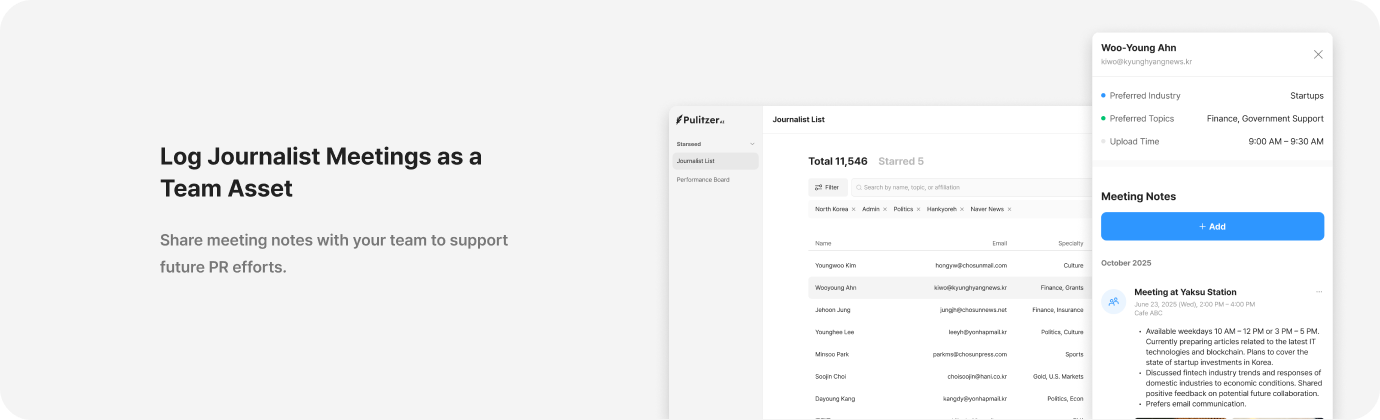
Using data from 10,000+ journalists, you can quickly identify:
each journalist’s coverage areas
their publishing patterns
when they tend to publish articles
If you’re unsure who to contact or when to reach out, start with data instead of guesswork. Finding the right journalist becomes much clearer. ✨