

![[EP02] PR in Korea: What to Know Before Reaching Out to Journalists](https://static.pulitzer.ai/homepage-blog/22/2026/03/19/113125_21934e3c-9669-4f3a-a4db-6ce3ee3450f2/83.jpg)
[EP02] PR in Korea: What to Know Before Reaching Out to Journalists
New to PR in Korea? Learn how to contact journalists, approach first meetings, and build better media relationships with the right etiquette and timing.
PR for Beginners — EP02
In the last article, we explored the different types of media outlets in Korea and the daily rhythm of a journalist’s work. This time, we’re moving into something more practical: how to make your first connection with a journalist. This step matters more than many people think. A company’s value, long-term vision, or growth potential is not always easy to communicate through a press release or a press kit alone. Those things often come across more clearly in conversation. And beyond the business side of PR, relationships are still built person to person, little by little.
Journalists receive a huge volume of emails and materials every day. So what makes one message stand out from the rest? Sometimes, it is simply familiarity. Journalists are people too. If they have spoken with someone from your company before, or remember a PR contact as thoughtful, clear, and professional, they may be more likely to give your materials a closer look.
This matters even more for startups and small or mid-sized companies. Large corporations often attract media attention more naturally, but earlier-stage companies usually need more proactive communication from their PR team in order to get noticed.
How should you make the first contact?

When reaching out to a journalist for the first time, email is usually the most common and least burdensome option. In many cases, you can find an email address through the journalist’s byline or on the publication’s website. Email also works well when you want to share a company introduction, a press kit, or a short meeting request. The downside, of course, is that journalists receive countless emails, so even a well-written message can easily get buried in a crowded inbox.
Text message can also be effective if you already have the journalist’s mobile number. It often has a higher chance of being seen than email. KakaoTalk(or even Whatsapp) may have an even higher open rate, but some journalists feel uncomfortable receiving a first introduction that way, especially from someone they do not know yet. For that reason, a brief and polite text message is often a safer way to start. After that, you can adjust based on the journalist’s communication style.
Phone calls are the most direct option, but they usually require more caution. Many younger journalists are more comfortable with text-based communication, and an unexpected call can interrupt their workflow. Unless the matter is urgent, it is often more natural to send a short message first and ask whether there might be a convenient time to speak.
For your first outreach, there is no need to overcomplicate things. A short self-introduction, a brief explanation of who you are, and a polite note saying that you would appreciate the opportunity to meet is usually enough.
Want to find the right journalists before reaching out?
Use Pulitzer AI’s Media Bridge to discover who covers your industry and how they typically publish. → Explore Media Bridge 🔎
If a meeting is scheduled, what etiquette should you keep in mind?

Once a meeting is arranged, it helps to be thoughtful about the logistics. The date can usually be coordinated around mutual availability, but when it comes to time and location, it is generally considered good practice to take the journalist’s schedule into account first. Journalists often move between interviews, meetings, and field reporting, and their schedules can shift quickly. Choosing a location that fits their route or making the meeting easier for them to attend can leave a positive impression.
If the meeting involves a meal, it is a good idea to ask in advance whether they have any preferences regarding cuisine or area. If they do not have anything specific in mind, suggesting a few options yourself is perfectly fine. In many cases, the company hosting the meeting covers the cost. At the same time, it is important to stay mindful of professional and legal guidelines related to meals and hospitality.
As for length, a lunch or coffee meeting usually works well within thirty minutes to an hour. If the conversation continues afterward, setting aside up to an hour and a half is generally enough. The tone of the meeting should not feel overly rigid. The best conversations tend to be a natural blend of work-related discussion and light, comfortable small talk. If the journalist is talkative, it makes sense to follow their lead. If they are quieter, a few gentle questions can help the conversation settle into a more relaxed rhythm.
Preparing for your next media meeting?
Keep track of journalist preferences, past conversations, and coverage history in one place. → Organize media contacts with Media Bridge
FAQ

Q1. What if they do not respond?
If you reach out and hear nothing back, there is no need to panic. In most cases, it is perfectly reasonable to follow up a couple of times through email, text, or phone. Two or three attempts are usually acceptable. If there is still no reply after that, it is better to assume that they are not interested in meeting at the moment.
That said, there are always exceptions. A journalist may be traveling, on vacation, or simply overwhelmed with deadlines. After giving it some time, one more follow-up can still be appropriate. The key is to remain polite and measured rather than persistent to the point of discomfort.
Q2. How much should you say in a meeting?
This is one of the most important things to keep in mind. Anything you say to a journalist can potentially become part of a story. That means you should be careful when discussing internal matters that have not been finalized, confidential information, or anything your company is not ready to make public. If something genuinely needs to be shared in confidence, it may be discussed off the record. Even then, it is wise not to assume that every boundary will always be interpreted in exactly the same way. Caution still matters.
At the same time, a meeting should not become so guarded that it feels empty. If you only repeat safe, obvious statements, the conversation may not give the journalist anything useful or memorable. Good PR is not about saying nothing, but it is also not about saying everything. The real skill lies in understanding what can be shared, what should not be shared, and how to respond with judgment based on the journalist’s questions and interests.
Sometimes, if a piece of information could be especially meaningful for the company, it may even be shared strategically with a specific journalist first as the basis for an exclusive story. When handled carefully, that can become a strong opportunity for both sides.
Q3. Do you need to accept evening meetings?
Since the pandemic, evening meetings in Korea have become less common than they once were. Even so, some journalists still prefer them, and there are situations where an evening schedule may still come up. In some cases, those meetings may also involve alcohol. Because of that, it can be helpful to decide your own boundaries in advance. For example, you might determine how often you are comfortable with evening meetings each month and suggest alternative times when needed. Having your own standard makes it easier to respond naturally and consistently.
It is also generally wise to be cautious about one-on-one evening meetings with a journalist of the opposite sex. If needed, a group setting or attending with another PR colleague may feel more comfortable and appropriate.
Q4. How often should you meet with journalists?
There is no single rule that applies to every relationship. Some journalists and PR contacts communicate frequently enough that meeting once a month feels natural. In many other cases, meeting once a quarter or once every six months is more common. It is also worth remembering that not every interaction needs to be a formal meal. A short coffee, a quick check-in, or a conversation around a relevant issue can be enough to maintain a good relationship over time.
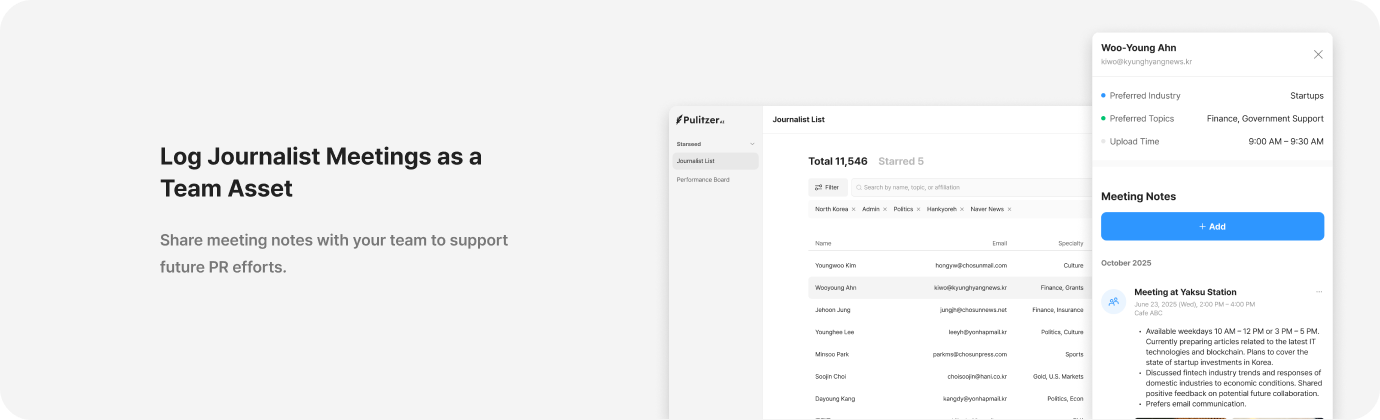
Relationships last longer when they are recorded
A first meeting does not complete the relationship. In many ways, it is only the beginning. Over time, it becomes easy to forget a journalist’s communication style, the topics they care about, or what came up in your last conversation. Once you are managing multiple media contacts, keeping all of that in your head becomes almost impossible.
That is why even simple records can make a real difference. When meeting notes, preferences, past conversations, and journalist background information are recorded consistently, relationships become much easier to manage over time. Tools like Pulitzer AI’s Media Bridge can help teams organize those details in a more structured way. Relationships are still built by people, not software. But good records make it much easier not to lose track of what matters.
Building media relationships over time?
Track journalist interests, meeting notes, and publishing patterns with Media Bridge. → Manage journalist relationships smarter
Coming next
In the next article, we’ll cover one of the topics PR beginners are usually most curious about: press releases from A to Z. We’ll walk through what a press release actually is, how it is typically structured, and what you should prepare when writing one for the first time. We hope this series continues to be useful for anyone starting out in PR in Korea. And as always, Pulitzer AI is cheering you on. ✨